Wednesday, 15 November 2017

Hollow Form Concepts


For this kind of 3D printing, the object in question needs to be self-supporting, so as not to collapse during the printing process. This requires designs with specific modifications. No flat planes can be added, because, with nothing to attach to, the plastic will simply fall to the base. This also means no steep angles, as lower levels of the object will not be able to support upper layers.

This was my first attempt at designing objects specifically for 3D printing. I was intrigued by the twist feature in Rhino and had fun playing around with it. For these objects in particularly, however, I'm unsure about the level of support necessary for the curves. Several appear steep enough to potentially cause problems while printing.


With these next objects, I tried to focus less on the spirals provided by the twist feature, and more on random combined shapes.


While I did like the second of these two designs, I wanted to go back to the twisted designs, but this time with a less pronounced twist.


After playing around with twisted objects I explored a kind of stacked objects.


Out of all designs, I think the stacked objects are far more likely to be successful because they don't rely on large twists and curves that could potentially prove to be disastrous prints.


Wednesday, 8 November 2017

Papercraft Final Revisions


First off I made an almost costly mistake while crafting my prototype (literally). I somehow managed to leave the lid off the brand new glue stick I bought for about four days. Thankfully, while the top of the glue stick was dry as can be, the sides were still sticky. I was able to chop off a thin layer from the top of the glue stick and salvage the rest. So, don't do what I did.

My vision for this toolbox replica was to craft a paper toolbox that was both functional and aesthetically pleasing. I mostly achieved the structure of such an object in my prototype, but visually the toolbox prototype was a blank canvas. In the critique ides were given to add structure to the inner walls of the toolbox (both for aesthetic and for better stabilizing the walls themselves). Other suggestions included trying for a Zim and Zou style (with layered multicolour paper), incorporation of the wooden texture from the original toolbox, a more rounded handle, layered designs, and crisper folds to be more precise. Out of these suggestions, I did fix the walls of the toolbox because it needed that support, and my folds were crisper for the final object. In terms of the design though, I decided not to go with the Zim and Zou method, but to go for something different.

I was inspired by images of the night sky that show visible light trails. Basically the entire sky is transformed into streaks of light. I used this idea to decorate the two tall sides of the toolbox. I incorporated the colours of the night sky: different shades of blue, purple, yellow, and white.

There were a few different tests I tried on the prototype before continuing on to the final object. This included adding interior walls for support. These walls were a pain to glue, but they solved the problem of the walls curving outward. At one point, I was also considering incorporating glitter into the piece, but the test on the prototype proved it to be lumpy and messy. I also tested out the cut paper siding by shredding card stock and printer paper. The card stock was too stiff to work with, but the printed paper was thin enough to manipulate into the designs I wanted.

I didn't realize until much later that using black paper in my design would complicate everything. Trying to print outlines  on black paper only resulted in impossible to see lines and curled card 1stock.


Here, you can sort of see the lines for the plan.


But at a distance, they became practically invisible and thus would not work.

This meant a change of plans in order to achieve the black toolbox I wanted. I had to print out all of the plans on white printer paper, layer the printer paper over the black card stock, and cut into both papers. 


This method of cutting took way longer than the original method of straight cutting through the card stock that I used for the prototype. Assembly of the toolbox itself also took a great length of time and many parts would not cooperate with the glue right away. Oddly enough the handle, the part that was most difficult in constructing the prototype, was the only step that went faster and easier this time around.

After printing, cutting, and assembling the parts of the toolbox, it was time to start decorating the sides. Which was much more time consuming than I had expected. I started by printing out different coloured printer papers.


After that, I shredded them using a paper shredder to get the long, thin strands I wanted.


The final product was not as detailed as I had originally intended it to be, but I ended up liking the end results for the siding because it ended up visually similar to the original layered design.


I did not end up getting all four sides decorated. The assembly and decoration of the toolbox took a significantly greater amount of time than I expected. I do, however, like that this resulted in a toolbox structured similar to the original with two sides that look similar and another two sides that look similar.


Part of the issue I had with the original toolbox was that there was no plan to it when I made it. Colours went wherever I felt like putting them, and patterns were chosen in the moment. I wanted the toolbox to be a more sophisticated version, and I think that having a simple monochrome black colour scheme works to achieve this, and the small decoration on the sides is enough to carry the piece. The mass of black in the centre of the toolbox is also a nice representation of the night sky when the visibility of stars is low.


This is the plan for the toolbox, separated into different sheets for printing. Each side was about the size of a piece of paper each to make cut and assembly easier.

Rhino Renderings:


I did not have an image reference for the cut paper strips, so it is presented in its inky-black state.


Tuesday, 24 October 2017

Papercraft Toolbox Prototype


For this papercraft prototype, I chose the toolbox design from the previous post. It was based on a wooden toolbox I put together in grade 6, and later in this post I will provide a side-by-side of the prototype and the original object for comparison.


Using Rhino, I turned the toolbox design and plan into printable sheets (as shown across the top in the image). There were not originally this many sheets as I tried to start small.


Starting small was not a good idea for this design. The object could have worked well at this size with the rectangular base and taller faces on the sides, however, the dimensions made it very difficult to construct the post. It was incredibly hard to glue the tabs to the post on the big object I ended up making, and nearly impossible for a first-time papercrafter like me to be able to do such a thing with this tiny piece.

As well, I initially had problems folding the cardstock. By using the paperclip to score I ended up not getting the lines I wanted and, because I was using coloured paperclips, some of the colour would rub off onto the paper.

Unhappy with the lack of progress, I switched to larger dimensions and found an easier way to score the paper. I found I like using the backside of the hobby knife much better as its duller than the blade but the point still drives a decent enough dent into the paper that makes folding easier.


The second time around, I made the plans large enough that the biggest pieces fit the majority of the cardstock.


After cutting out the cardstock pieces, I began assembling the toolbox starting with the rectangular base.


To attach the handle to the base, tiny tabs were glued to the interior walls.


This is the finished prototype (right) beside the original toolbox (left).

The papercraft toolbox did not end up as detailed as i had planned. This was due to my early struggles folding and gluing as well as the challenge of putting together the handle. The exterior walls of the base not connected to the six sided polygon are more rounded and floppy than I would like and some sort of support to make them more rigid will likely be needed going forward. As well, a sturdier solution to the handle tabs might be in order. Even though the small tabs worked this go round they were very difficult to put in place and could prove unreliable.


Tuesday, 17 October 2017

Objects Unfolded


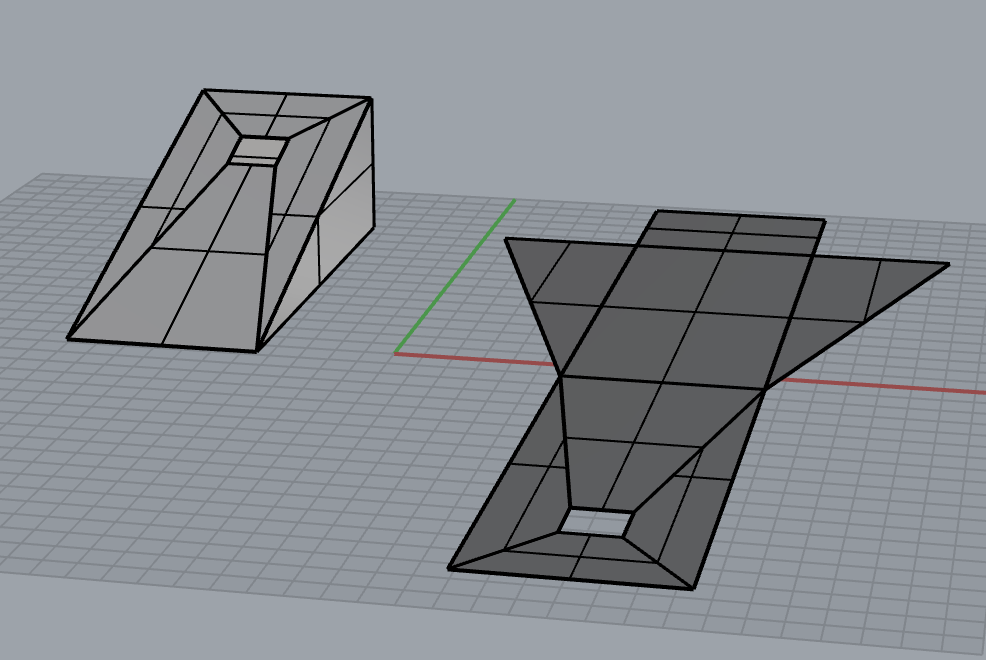
For this project I have ten objects that I've encountered in my lifetime that I have designed in Rhino that have been unfolded into flat templates for easy printing. 

Pool Cue:


First off is the pool cue. I honestly cannot remember a time without the pool table, I'm sure it was purchased long before I was born. I am absolutely terrible at the game and only play with close friends. I didn't choose the pool cue because I'm a pool champion though. I have strong memories of the pool table at my old house; my brother and his best friend used to play all the time. That was so long ago I probably wasn't tall enough to play myself but I loved watching and the table was in a tight enough space that you had to dodge pool cues when the guys took their shots so the object definitely came to mind when I started this project.

Marker and Cap:


Honestly, the marker is probably what got me into art. When I was younger I was glued to colouring books and I always hated crayons with a passion. Even now I like incorporating marker into my art every once and a while so I'd say it's been with me while I've grown as an artist.

Tool Box:


This is the only thing I've ever really built. I'm not sure how my middle school teachers managed to get me to do this. But honestly it's something I was really proud of when I built and had to try building in Rhino. 

Lamp:


I've had the same lamp for at least a decade. From when I used to stay up late reading to now when I fall asleep doing homework and I accidentally leave it on. As well as the time when I was younger and I almost started a fire because I could turn the light green by putting a plastic green cup over the lightbulb! The object fits right in to this collection.

Marbles Board:


I never met my great grandpa but he built like a dozen decent board games (all the same game) for members of his family. My family has at least one, my grandparents have a couple and so on. It's like the game Sorry but the board forms a hexagon shape and there are small indents in the board (not shown in the 3D model) for marbles to sit and be moved around as pawns. This game gets overplayed around Christmas.

Bean Bag Toss:


I have family friends that are super competitive and for some reason they these giant planks with a hole cut through them (circular in real life but square in the 3D model). They're used for ridiculously intense games of bean bag toss where its like 1 point if you toss one and it lands on the surface of the plank and 3 if you get one through the hole. 

Pumpkin: 


Halloween is like the best holiday in my opinion. For one, there's free candy (until you get older and it sadly becomes less socially acceptable to beg strangers for sugar). But I've always been a fan of the typical horror stuff around Halloween and Halloween traditions. The pumpkin is like a Halloween icon and since it's October I had to try to create my own version (which kinda turned out looking like a squashed candy apple- which is at least still within the Halloween theme!)

Tardis Mug:


There are two times when I seriously need tea. One is when I'm reading or writing because I've come to associate that with being sophisticated or like the stereotypical reader/writer. The other is during long, intensive study sessions. Basically, tea got me through high school and will hopefully lend a hand during my ACAD years as well. I couldn't just make any typical mug though. No, I'm a bit of a geek so I re-created the mug I own that's shaped like the Tardis from Doctor Who. There's a space between the rectangular prism and roof shape to show that it's a lid. 

Golf Club:


I've played golf for years. Frankly I'm still terrible at it, but I've put in plenty of hours practicing. The way I designed it is more like a double-sided putter you'd find at a mini golf place. The club also brings back childhood memories of time spent in my grandparents' basement with a made up game that involved asking people to toss golfballs at me so I could block it with the club (it sounds a lot more dangerous than it actually was I swear!).

Chopsticks


Alright, a lot of the objects I've created thus far have had connections to my childhood. This object is an outlier. I did not grow up using chopsticks. My sister and mom have a package of them they use occasionally. I included them on this list because I have recent connections to them. In grade eleven I spent two weeks on a class trip to Japan and it was without a doubt the best trip I've ever been on. We had teachers and school councillors as chaperones and mine decided to gift our group with some cute chopsticks she'd found, which of course I still have. Ironically enough, my skills when it comes to handling chopsticks are, well, choppy. I don't hold my pencil properly so holding chopsticks is also difficult so sometimes it works out and other times it just doesn't.


I honestly love the design of my marker, I feel like I got the tip just right. While working on some objects I realized that layering shapes doesn't always work out and that it can make the flat template difficult or even impossible. For some of the objects I just had to separate the problem shapes into their own mini templates.


You can see here that the hexagon has nowhere to fall because the rectangle it stands on impedes its path.


The same problem exists between the side of the toolbox and the pole.


And finally between the stem of the pumpkin and the top piece.